

Source: Local Planning Authorities
TPO Checker & Tree Preservation Order Map
Search a postcode or address to check mapped Tree Preservation Orders before buying, designing a scheme or carrying out tree works.
Last checked by Maplify: September 2026
What This Layer Shows
This layer plots Tree Preservation Orders (TPOs) published by Local Planning Authorities under the Town and Country Planning Act 1990. TPOs protect trees and woodlands in the interests of amenity, restricting cutting down, topping, lopping, uprooting, wilful damage or destruction without the authority's written consent. Government guidance also treats root cutting as prohibited work.
Orders can protect an individual tree, a group of trees, a woodland or trees within a defined area. Coverage and publication formats vary between authorities, so Maplify is designed for early screening and the council's own order remains the record to verify before work or a transaction.
Why It Matters
TPOs directly affect what a landowner, developer or contractor can legally do to a tree, and unauthorised works are a criminal offence under Section 210 of the Town and Country Planning Act 1990. Checking this layer before any tree work, garden landscaping or development proposal avoids inadvertently committing an offence and the substantial fines that follow.
For development sites, TPO trees can materially constrain the buildable area through Root Protection Areas, meaning the designation is often checked at feasibility stage, well before a formal arboricultural survey is commissioned.
How to Interpret the Map
Individual Tree Order
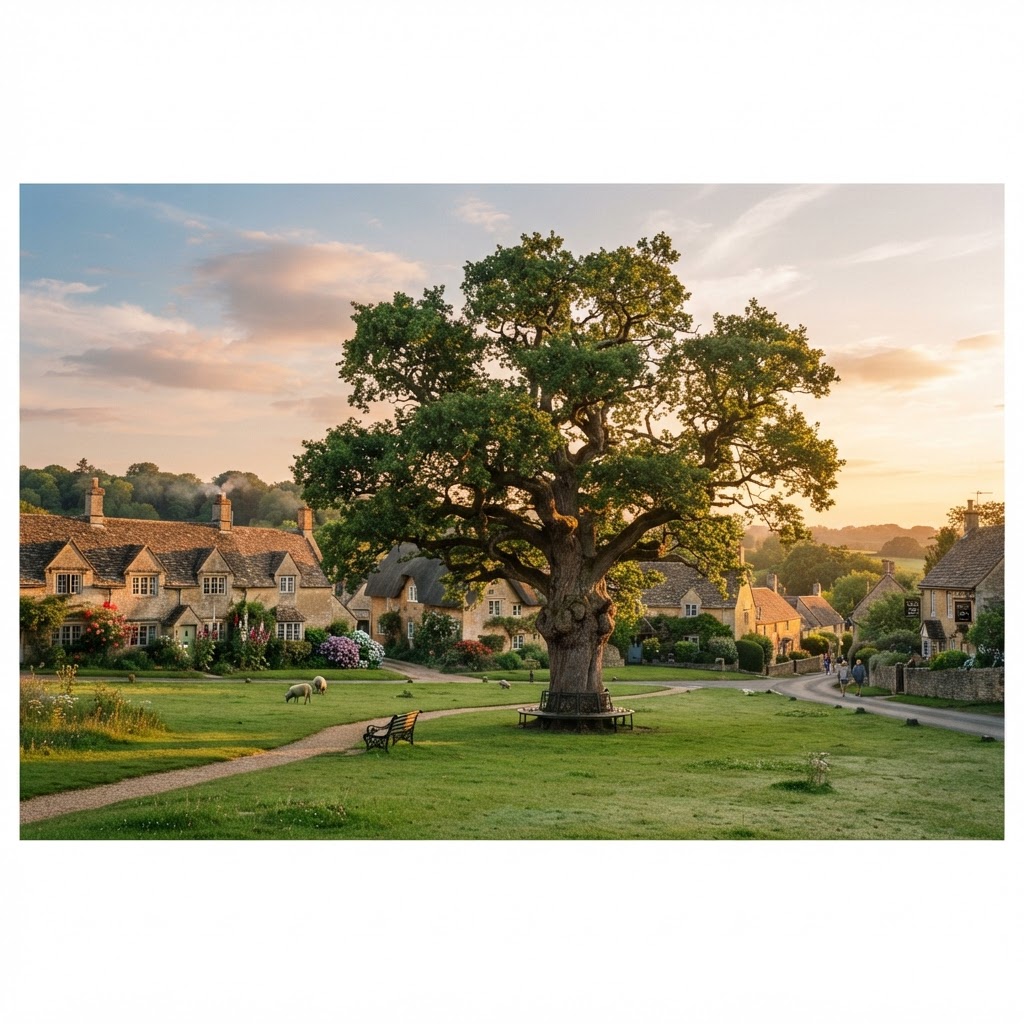
Protection for a specific specimen tree of high amenity value — an ancient oak, rare species or landmark tree.
Group Order
Protection for a group of trees forming a cohesive feature, such as avenue planting or an amenity group.
Woodland Order
Protection for a defined woodland area as a whole, including semi-natural and ancient woodland sites.
Area Order
Protection for all trees within a defined area, commonly used on housing estates and in public parks.
Tree Preservation Orders Layer in the Maplify Map
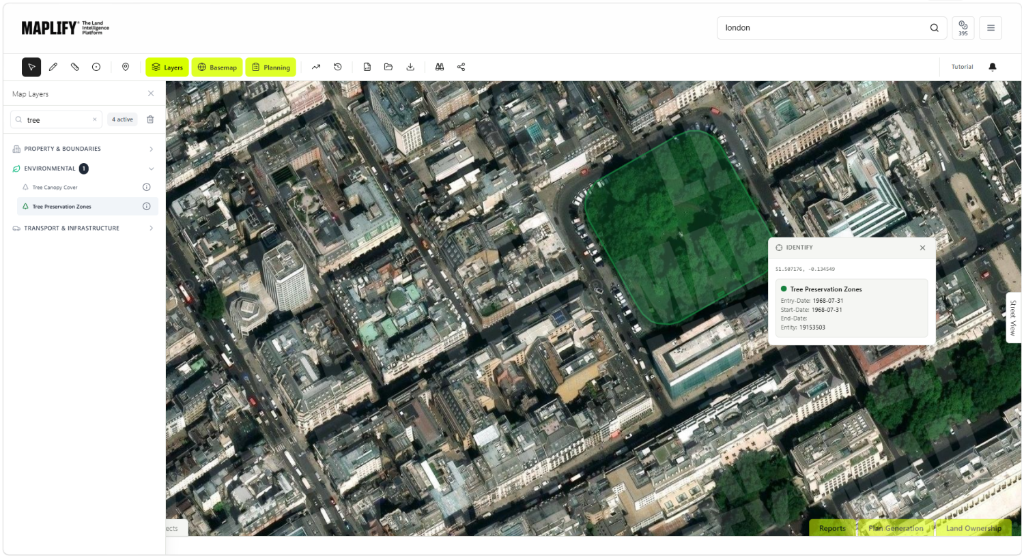
The Tree Preservation Orders layer enabled on the Maplify map, showing a protected tree zone identified against a site using the layer identify tool.
Planning and Development Implications
Development sites with TPO trees generally require an Arboricultural Impact Assessment following BS 5837:2012, including a tree survey, calculated Root Protection Areas and a Tree Protection Plan submitted alongside the planning application. Encroachment into a Root Protection Area may require specialist no-dig construction methods or a redesigned layout to keep structures and services clear of root systems.
A TPO does not prevent development outright, but it does mean tree removal or works require the local planning authority's consent — applications are free and must be determined within eight weeks, and consent can be refused or granted subject to replacement planting conditions.
What to Do When a Site Is Affected
- 1Confirm the exact order type and protected trees with the local planning authority's tree officer.
- 2Commission a BS 5837:2012 tree survey and Arboricultural Impact Assessment if any development is proposed near a protected tree.
- 3Apply for TPO consent before any felling, pruning or works likely to affect the tree's roots.
- 4Check whether the site also sits within a conservation area, which brings a six-week notice requirement even for unprotected trees.
- 5Budget for replacement planting conditions if removal or significant works are unavoidable.
This is general guidance, not professional or legal advice — confirm specifics with the relevant authority or a qualified professional.
Official Data Source
Data Freshness
Important Limitations
- TPOs shown on Maplify are for screening — confirm exact protected trees and boundaries with the local authority tree officer before any works.
- Newly made or provisional TPOs may not yet appear if the local authority has not published updated data.
- Individual tree locations are approximate; a formal tree survey is required to confirm species, condition and precise position on site.
- This map does not replace a BS 5837:2012 arboricultural survey for development near protected trees.
Common Use Cases
Property Developers
Identify TPO constraints on Root Protection Areas before finalising a site layout.
Planning Consultants
Advise clients on consent requirements and likely conditions for affected schemes.
Architects
Design around retained trees and their protected root zones from the earliest stage.
Surveyors
Flag TPO trees during condition surveys and valuation reports.
Landowners
Understand what garden or land management works require consent before commissioning them.
Environmental Consultants
Cross-reference TPO trees with wider ecological surveys and habitat assessments.
Related Layers
Tree protection checks are commonly run alongside these related layers.
Related Guides
Frequently Asked Questions
How do I check if a tree has a Tree Preservation Order?
Search the site on Maplify and enable the Tree Preservation Orders layer. Protected trees, groups, woodlands and areas are shown against the local authority record.
What work can I do to a TPO tree without consent?
Written consent is generally required before cutting down, topping, lopping, uprooting, wilfully damaging or destroying a protected tree. Root cutting is also treated as prohibited work. Limited exemptions can apply, so confirm the position with the local planning authority before starting work.
What are the penalties for unauthorised works to a protected tree?
Unauthorised work to a protected tree can be a criminal offence and may lead to substantial fines, including unlimited fines for serious offences. The exact penalty depends on the offence and court, so check current government guidance and obtain consent before carrying out work.
Do TPOs apply to trees in conservation areas?
Trees in a conservation area without a specific TPO still require six weeks' notice (a Section 211 notice) to the local planning authority before most works, giving the council the opportunity to make a new TPO.
How do TPOs affect a development site?
Development sites containing TPO trees generally require an Arboricultural Impact Assessment under BS 5837:2012, including Root Protection Areas and a Tree Protection Plan, which can constrain layout, access and foundation design.
Can a TPO be removed to allow development?
A TPO can be varied or revoked by the local planning authority, but this is uncommon and requires a strong justification — a felling licence or planning permission does not automatically override a TPO.
Check Tree Preservation Orders on Maplify
Open the map, generate a site report or save your search to come back to it later.
Reviewed by the Maplify data & editorial team
Maplify displays official-source data for desktop screening and due diligence. We document where each dataset comes from, how it is processed, when it is checked and where its limitations matter.